Invasive Species . . .
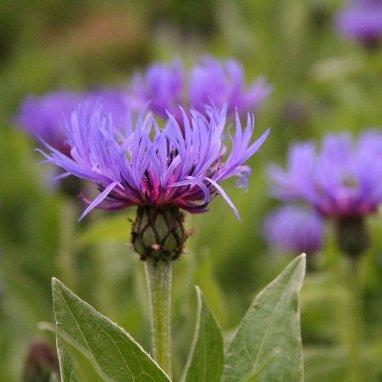
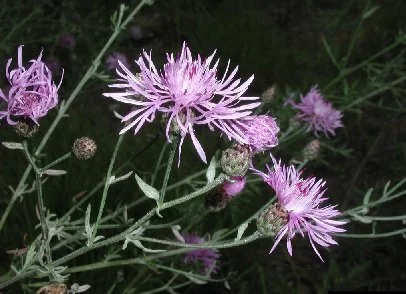
PHOTOS BELOW: Knapweed
Background, News and Updates
In our effort to preserve the true natural environment we’ve inherited, we are concerned, of course, by the introduction of invasive species to our property.
Read below for specific information.
URGENT BULLETIN
Request for help in our eradication effort.
Please click HERE for information about helping our good neighbor Kathleen Mayhew continue her urgent effort in leading the charge to rid MIPCA (as best as possible) of Knapweed.
KNAPWEED: WARNING!! IF YOU SEE THIS NOXIOUS WEED ON YOUR CAMPSITE, PLEASE PULL IT OUT AND BE SURE TO GET THE ROOT WITH IT. THIS IS THE TIME OF YEAR IT BEGINS TO FLOWER Knapweed is an invasive species of perennial that chokes out native wildflowers, while causing deleterious changes to the soil of an area in which the perennial grows. The weed is, again, becoming increasingly prevalent at Middle Island Point, and worse yet, is choking out the wildflowers. A few years ago, intrepid Campers united and we had “pulling parties” and went to campsites where seasonal Campers were not yet here, and we pulled the weeds. In addition, the work party individuals pulled weeds from their own campsites. We almost entirely eradicated Knapweed from Middle Island Point property. However, the weed is so invasive that measures must be taken every year so that we are not ever again over run by this weed. Knapweed possesses carcinogenic properties and must be handled with extreme care. The Conservation Office staff suggests the use of leather gloves, long sleeves and long pants for handling the weed. My own experience was that I was nauseated and had an upset stomach for a few days after pulling the weeds for hours on weekends. I suggest you find your unused COVID masks and put them to good use for pulling the weeds from your campsite. The Conservation Office also suggests bagging the weed in black plastic garbage bags. If tightly tied and kept in the sun, the weed will die and the bags can be thrown in the trash collection for disposal in the landfill. Please pass along this notice to your neighbors so we are all working together to eradicate this noxious weed. Thanks for your assistance! Hope you have an enjoyable weed and bug less summer. Kathleen Mayhew Campsite 38
Some Online and Local Resources for Responsible Landscaping
" Gardening with Native Plants - A Guide for the UP"
Maria Janowiak
March 2020
www2.dnr.state.mi.us/publications
Grasses and Ground Covers
Designs by Nature UP Native Plants
www.upnativeplants.com
Evergreen Nursery on M 94 west of Chatham
Native trees and shrubs
MSU Extension
canr.msu.edu
Marquette County Conservation District -- plants , information, assessments
marquettecd.com
DO NOT PLANT:
Miscellaneous:
Autumn Olive tree
Giant hogweed
Japanese knotweed
Common reed phragmites ( BIG problem in Wisconsin )
Purple loosestrife
Trees :
Norway maple
Tree of Heaven
Bradford pear *
Buckthorn *
Groundcovers (Asterix highlights particularly bad plants.
Gout weed *
Lily of the valley *
Periwinkle vinca *
Lesser celandine
Ajuga bugleweed
Chameleon plant
Evening primrose
English ivy *
Muehlenbeckia
Bears breeches
Japanese bloodgrass
Italian arum
Beach vitex *
Creeping jenny
Field blindweed
Ice plant
Japanese honeysuckle
Kudzu *
Winter creeper
Yellow archangel
Ribbon grass
Japanese pachysandra
Others including shrubs
Butterfly bush ( outcompetes native plants for pollinators )
Burning bush ( euonymus )
Privet hedge
Sacred bamboo
Japanese spirea
Japanese barberry
Asiatic bittersweet
Linden viburnum
Gulalia grass
Orange daylily
Poison hemlock ( conium )
Dames rocket
Queen's Ann lace
Garlic mustard
Chinese wisteria
Tansy
SAFE TO PLANT
Ground Covers
Bearberry
Blue-eyed grass
Wild Strawberry
Creeping phlox
Wild geranium
Foam flower
Canada anemone
Ferns - Maidenhair, Ostrich, Interrupted
Others ( a partial listing not exhaustive )
Cutleaf anemone
Wood anemone
3 toothed cinquefoil
Path rush
Beach peas ( very desirable on our beach )
Sedges - dewey, shining bur, necklace, fox , ivory
Wild petunias
Violets `- sweet white, wood
Phlox - wild blue, prairie
American beach grass
Barren strawberry
Jacobs ladder
Lance leaf coreopsis
Wild ginger
Bluet
Aster
Black eyed susan
Native Trees
There is value in mixing hardwoods into conifer areas and vice versa for wildlife and for future forest succession
White birch
Yellow birch
Black spruce ( susceptible to spruce bud worm )
White spruce ( susceptible to spruce bud worm
Tamarack ( needs wet ground but if present, excellent variety )
Balsam fir ( slow growing , susceptible to spruce budworm)
Hemlock
White pine
Red pine
Jack pine ( short lived and negative as a monoculture )
White cedar ( particularly valuable but require deer protection for the long haul as slow growing )
Ground juniper
Red oak
White oak
Sugar maple
Red maple
American beech ( much reduced with beech leaf disease , a nematode )
Ash ( much reduced with emerald ash borer )
Aspens quaking and bigtooth
Basswood ( fast growing )
Black cherry
Shrubs support wildlife -- not exhaustive list
Red osier dogwood
Ninebark
Serviceberry
Elderberry
Choke cherry
Blueberry
Nannyberry
Bunchberry
Hawthorn
Hackberry
Raspberry
Thimbleberry
Turning Your Backyard Into A Wildlife Habitat
For information about incorporating native species into your landscaping design, click HERE.
POISIN HEMLOCK ALERT
Member Jim Croom brings the following article to the attention of others:
FROM THE LEENENAU PENNINSUL via JIM CROOM
Here’s a link to an invasive species warning that the Association the Crooms are part of in the The Leenenau Peninsula in lower Michigan has sent its members.
https://lakeleelanau.org/combating-purple-loosestrife-in-lake-leelanau/